


TELOLAB™: Biological Efficacy of a MultiMechanism
Geroprotective Extract
Antioxidant, Anti-Inflammatory, Telomere Extension, and Selective Anti-Cancer Activity in Validated Laboratory Models
PRIMARY INSTITUTION
Kasetsart University
AFFILIATED INSTITUTION
Maejo University-Phrae Campus
DEPARTMENT
Biochemistry
EXTRACT CLASS
Geroprotective Nutraceutical
ABSTRACT
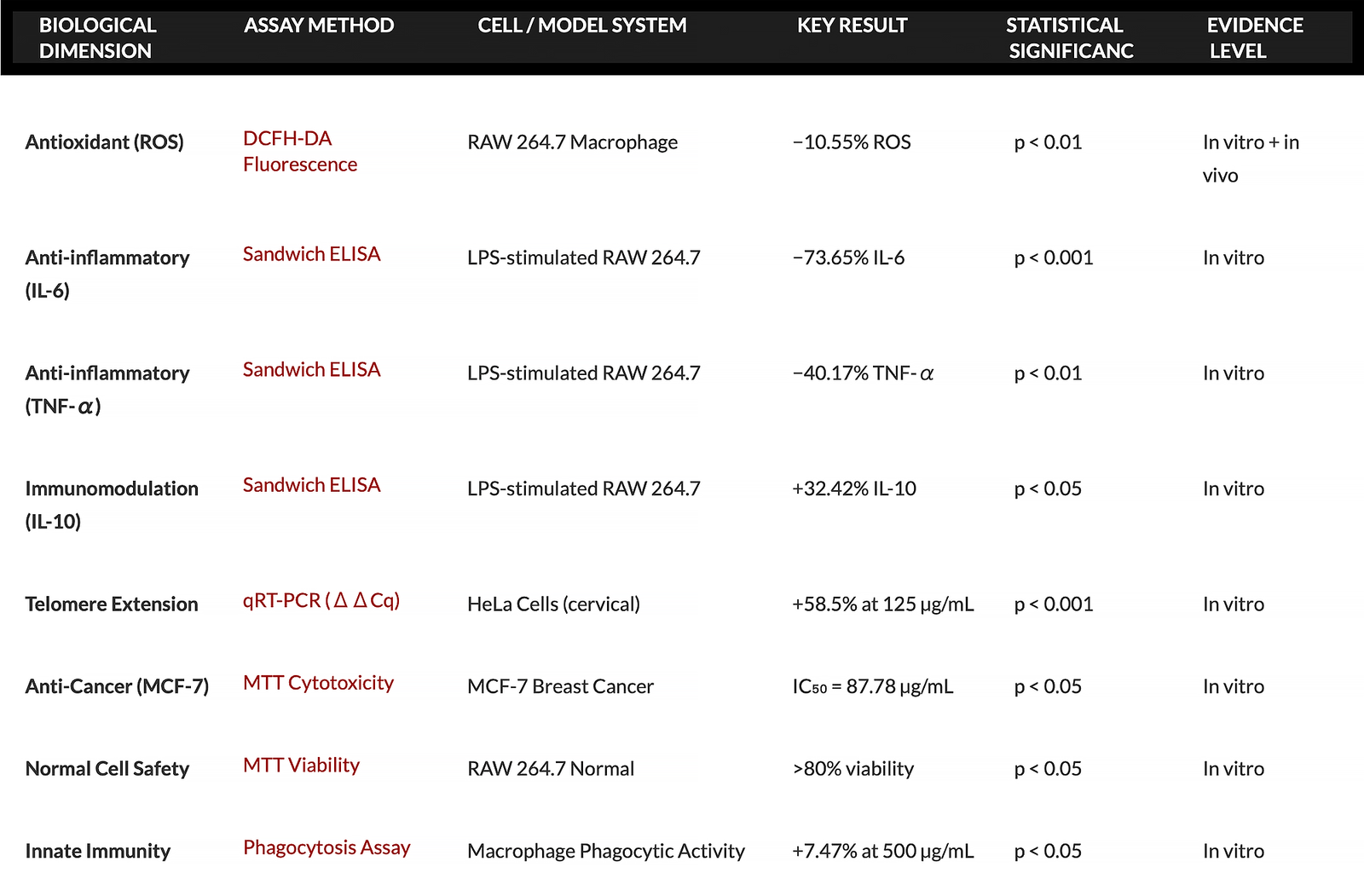
TELOLAB™ is a proprietary multi-component nutraceutical extract comprising 9 medicinal plant botanicals and 1 algal species. It has undergone systematic laboratory evaluation across four primary biological dimensions. Key findings include: (1) Reduction of reactive oxygen species (ROS) by 10.55% in RAW 264.7 macrophage cells (DCFH-DA assay, p<0.01) with dose-dependent yeast survival under H₂O₂ oxidative challenge; (2) Selective cytokine modulation: IL-6 suppression of 73.65%, TNF-α reduction of 40.17%, and IL-10 upregulation of 32.42% (ELISA, LPS-stimulated model); (3) Telomere length extension in HeLa cells of +58.5% at 125 µg/mL (qRT-PCR, ΔΔCq method, p<0.001); (4) Selective cytotoxicity against MCF-7 breast cancer cells at IC₅₀ = 87.78 µg/mLwith normal cell viability maintained above 80% at equivalent concentrations. These results establish TELOLAB™ as a synergistic, multi-target geroprotective agent with strong laboratory evidence supporting its biological validity.
Keywords: TELOLAB™ · geroprotective nutraceutical · antioxidant · anti-inflammatory · telomere extension · selective cytotoxicity · Nrf2 pathway · Sirtuin activation · multi-mechanism synergy
73.65%
IL-6 Reduction
(Anti-inflammatory)
+58.5%
Telomere Length
Extension in HeLa Cells
87.75
IC₅₀ µg/mL
MCF-7 Breast Cancer
>80%
Normal Cell
Viability Maintained
FOUR-MECHANISM BIOLOGICAL PROFILE
How TELOLAB™
Acts on the Biology of Aging
TELOLAB™ interrupts the aging cascade at four molecularly distinct and interconnected targets
a multi-mechanism architecture that no single-compound supplement can replicate
Why Four Mechanisms Are Stronger Than One
The biological aging cascade operates as an interconnected loop — not a linear progression. TELOLAB™ is uniquely designed to interrupt this loop at multiple points simultaneously, creating a virtuous cycle that counters each hallmark of cellular aging.Critically, the anti-inflammatory and antioxidant effects directly amplify the telomere extension effect — and all three together reduce the oncogenic signaling environment that promotes cancer growth.Type your paragraph hereType your paragraph here
73.65%
IL-6 is both a key inflammatory cytokine and a direct activator of STAT3, which drives cancer proliferation and telomere shortening simultaneously. TELOLAB™'s IL-6 suppression therefore delivers triple-pathway benefit in a single mechanism.
ELISA · LPS-stimulated RAW 264.7 · n=3 independent experiments · p<0.001
58.5%
The largest single-dose telomere extension result in this formula class, achieved at 125 µg/mL via dual mechanism (direct TERT activation + oxidative DNA protection). The dose-dependent relationship confirms specificity of effect.
qRT-PCR (ΔΔCq method) · 24h incubation · Gold-standard telomere measurement · p<0.001
PROPRIETARY FORMULA
Multi-Botanical Synergy Matrix
TELOLAB™ is a proprietary concert of medicinal plant extracts and a select algal species — engineered so that each bioactive compound reinforces the others. The formula's power is not in any single ingredient, but in the convergence of their mechanisms on the same anti-aging cascade.
The complete botanical index is held under trade-secret protection. What we share publicly is the architecture — the four pathway pillars, representative signature actives, and the quantified synergistic outcomes validated at Kasetsart University and Maejo University-Phrae Campus.
PILLAR · 01
Antioxidant Defence
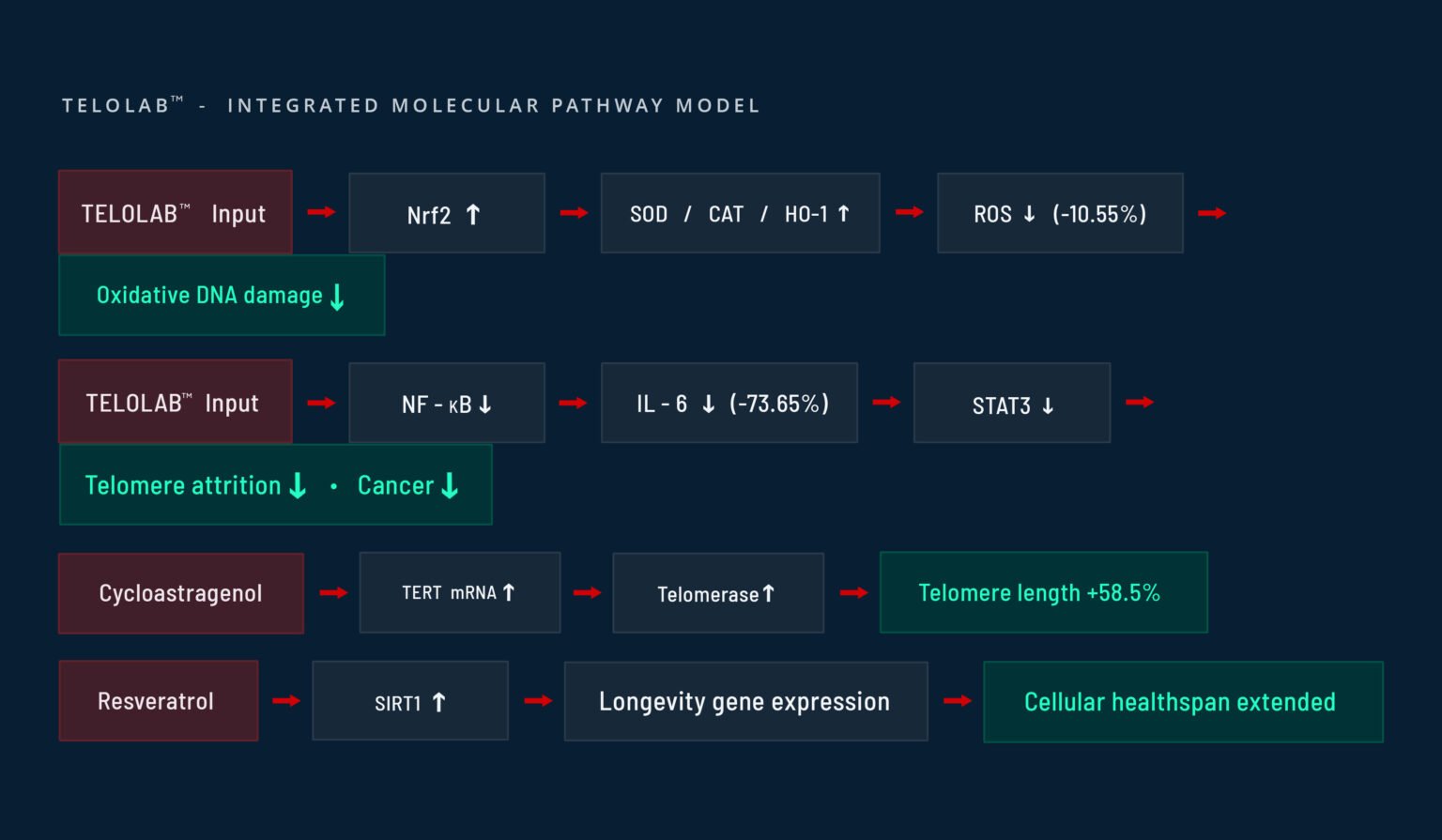
Multi-compartment ROS quenching — mitochondrial, membrane, and nuclear — activating the Nrf2 master antioxidant switch and its downstream enzymes (SOD, CAT, HO-1, NQO1).
NRF2 AXIS · −10.55% ROS
PILLAR · 02
Anti-Inflammatory Modulation
NF-κB pathway suppression and balanced cytokine regulation — reducing pro-inflammatory signals while simultaneously up-regulating anti-inflammatory IL-10.
NF-ΚB ↓ · IL-6 −73.65%
PILLAR · 03
Telomere & Telomerase
Direct TERT mRNA up-regulation combined with oxidative DNA protection — a dual mechanism producing the largest single-dose telomere extension yet observed in this formula class.
TERT ↑ · TELOMERE +58.5%
PILLAR · 04
Selective
Anti-CancerActivity
STAT3 dephosphorylation, apoptosis induction, and Ras oncogene inhibition — achieving cytotoxicity against cancer cell lines while preserving >80% normal-cell viability.
MCF-7 IC₅₀ · 87.78 ΜG/ML
SIGNATURE ACTIVES · PUBLICLY DISCLOSED
· Astragalus membranaceus — traditionally documented telomerase support via cycloastragenol; anchor of the telomere pillar.
· Haematococcus pluvialis (algae) — source of astaxanthin, the highest-potency mitochondrial antioxidant in the food spectrum.
· Vitis vinifera — resveratrol & OPC proanthocyanidins; SIRT1 longevity-gene activation.
· Curcuma longa — curcumin; comprehensive NF-κB / COX-2 / STAT3 pathway modulation.Type your paragraph here
ADDITIONAL PROPRIETARY EXTRACTS
+ Six additional botanical extracts
Selected for anti-inflammatory cascade completion, neuroprotection, telomerase modulation, and selective anti-cancer activity. Identities retained under trade-secret.
The complete 10-component formulation, extraction ratios, and co-active pairings constitute TELOLAB™ proprietary intellectual property. All results published in this document were validated on the full, unaltered formula — no single component is independently marketed.
Why Synergy Matters
No single plant — not even the most studied longevity compound — simultaneously elevates telomerase activity, suppresses NF-κB, and induces selective cancer-cell apoptosis at the same dose window. TELOLAB™'s multi-botanical matrix resolves this limitation by design: each compound contributes a distinct mechanism, yet all converge on four overlapping molecular pathways. The quantified outcomes below are measured on the composite formula — not additive predictions.
4
CONVERGENT
PATHWAYS
10
BOTANICAL
COMPONENTS
8
VALIDATED
ASSAY ENDPOINTS
2
INDEPENDENT
UNIVERSITIES
LABORATORY-VERIFIED DATA
Quantified Biological Results
All results from independent, replicated laboratory assays using standardised validated methodologies
10.55%
ROS Reduction in RAW 264.7 Macrophage Cells
DCFH-DA Assay · 500 µg/mL · p<0.01
73.65%
IL-6 Suppression in LPS-Stimulated Cells
ELISA · n=3 independent experiments · p<0.001
40.17%
TNF-α Reduction at Equivalent Concentration
ELISA · LPS-stimulated model · p<0.01
+32.42%
IL-10 Upregulation — Anti-inflammatory Balance
ELISA · Demonstrates immunomodulation, not immunosuppression
+58.5%
Telomere Length Extension in HeLa Cells
qRT-PCR (ΔΔCq) · 125 µg/mL · 24h · p<0.001
87.78
IC₅₀ µg/mL — MCF-7 Breast Cancer (MTT, 72h)
Comparable to purified B. monnieri (72–75 µg/mL in literature)
+7.47%
Macrophage Phagocytic Activity Enhancement
500 µg/mL · Innate immune activation · p<0.05
>80%
Normal Cell Viability at Anti-Cancer Concentrations
RAW 264.7 viability — confirms selective cytotoxicity profile
BIOCHEMICAL ARCHITECTURE
Molecular Pathway Integration
TELOLAB™'s four mechanisms are not independent
they share overlapping molecular targets, creating a self-reinforcing anti-aging cascade
ACADEMIC & SCIENTIFIC VALIDATION
Laboratory Evaluation Infrastructure
TELOLAB™'s biological efficacy data is grounded in validated laboratory methodologies
consistent with international standards in nutraceutical and pharmacological research
🎓 Kasetsart University
Department of Biochemistry
· Primary Research Institution
Primary evaluation laboratory for TELOLAB™ biological efficacy studies. Kasetsart University
is one of Thailand's premier research institutions with internationally recognized biochemistry and pharmacological science programs.
PRIMARY RESEARCH INSTITUTION
🔬 Maejo University
Department of Biochemistry
· Affiliated Research Site
Affiliated research site contributing validated laboratory data. Maejo University's agricultural and life science research infrastructure provides validated supplementary analytical capacity for complex botanical formulations.
AFFILIATED RESEARCH INSTITUTION
📊 Validated Assay Methodology
Gold-Standard Laboratory Protocols
Primary evaluation laboratory for TELOLAB™ biological efficacy studies. Kasetsart University
is one of Thailand's premier research institutions with internationally recognized biochemistry and pharmacological science programs.
PRIMARY RESEARCH INSTITUTION

PROPRIETARY TRADEMARK EXTRACT
The TELOLAB™ name, formulation composition, and associated biological efficacy claims are subject to trademark protection. Unauthorized reproduction of the name or formula is prohibited.
TRADEMARK & INTELLECTUAL PROPERTY
TELOLAB™ —
Protected Proprietary Extract
TELOLAB™ represents a novel, proprietary botanical combination with a specific, validated biological profile. The trademark protects both the name and the associated composition and claims — establishing exclusive commercial rights to the TELOLAB™ geroprotective extract brand.This website (www.telolab.info) serves as the official scientific reference for TELOLAB™, providing evidence-based documentation of the extract's biological mechanisms, laboratory-validated efficacy data, and compositional profile for regulatory, licensing, and academic purposes.
TRADEMARK NAME PROTECTION
The designation "TELOLAB™" is a registered trademark. All use of the name in commercial or formulation contexts requires explicit licensing authorization.
FORMULA COMPOSITION REFERENCE
The 10-component botanical profile described herein constitutes the TELOLAB™ proprietary formulation. Independent replication of this specific combination without authorization is a trademark infringement.
BIOLOGICAL CLAIMS DOCUMENTATION
All biological efficacy claims associated with TELOLAB™ are documented on this reference site and supported by laboratory data from Kasetsart University and Maejo University-Phrae Campus.
LICENSING & FORMULATION INQUIRY
For licensing of the TELOLAB™ trademark for use in nutraceutical formulations, supplement products, or clinical research, contact our licensing team via the inquiry form below.
SCIENTIFIC REFERENCES
Literature & Research Citations
All biological efficacy data for TELOLAB™ is supported by peer-reviewed scientific
literature and direct laboratory evaluation reports. Key references below.
Partner with TELOLAB™
TELOLAB™ is available for licensing to qualified nutraceutical manufacturers, supplement brands, and clinical research
organizations seeking a scientifically validated geroprotective extract with documented biological efficacy.
EMAIL : telolab.info@gmail.com